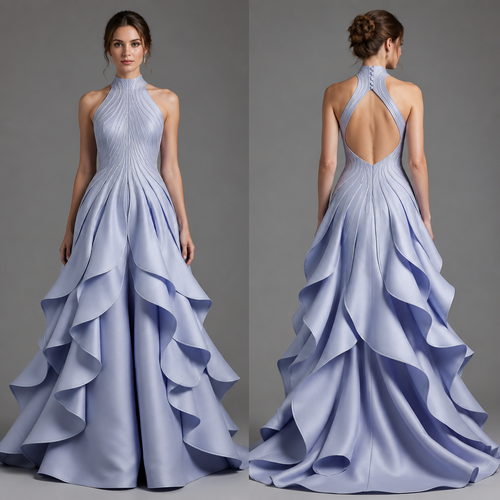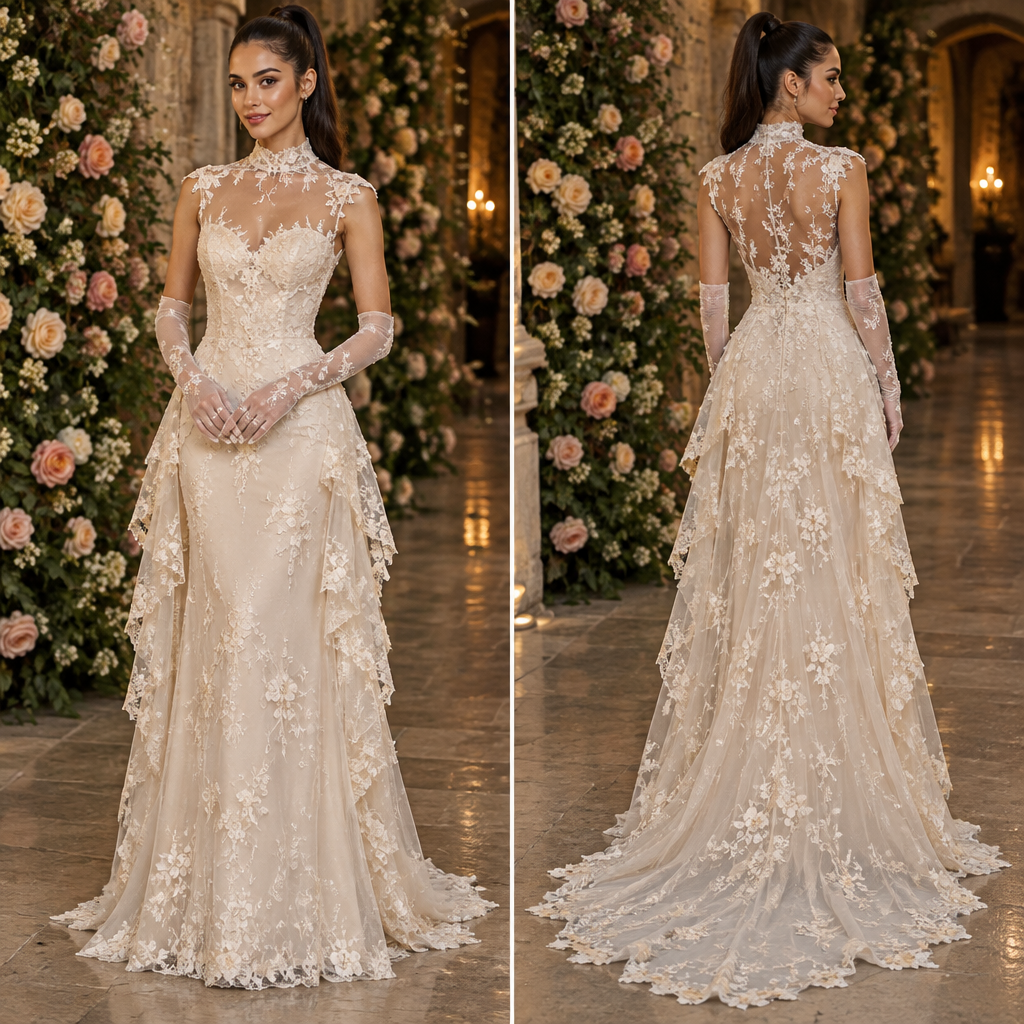
Create an ultra-realistic full-body fashion editorial photograph of an elegant young adult woman wearing an original ethereal ivory couture gown. The composition, styling, lighting, proportions, dress construction, and overall visual aesthetic should closely follow the specifications below.

The woman is standing upright in a relaxed three-quarter pose, facing slightly toward the camera while her head is turned subtly to her right. She has dark brown/black hair pulled tightly back into a sleek high ponytail, with the ponytail falling behind her head and over one shoulder. Her makeup is sophisticated but natural: softly defined eyes, subtle dark eyeliner, long lashes, warm neutral eyeshadow, softly glowing skin, lightly sculpted cheeks, and natural rosy-nude lips. She wears very small understated earrings. Her expression is gentle and confident with a subtle closed-mouth smile.

The photograph is vertical, full-body, editorial fashion photography, with the entire gown visible from the neckline to the bottom of the train. The camera is approximately at chest/waist height and positioned several feet away so the proportions of the gown remain natural. Use a realistic photographic lens with mild background depth of field, extremely realistic skin texture, realistic fabric texture, natural shadows, and high-resolution photographic detail. Do not make it look like an illustration, CGI, digital painting, plastic mannequin, or AI fashion render.

THE GOWN

The gown is a floor-length, fitted ivory couture evening/bridal gown with a narrow, elongated silhouette. It is romantic, delicate, sophisticated, ethereal, and luxurious, but NOT puffy, NOT a ball gown, NOT overly ornate, and NOT excessively layered.

The primary color is soft warm ivory, approximately an elegant antique ivory/cream rather than bright optical white.

The gown has a fitted structured bodice that follows the torso closely. The bodice has subtle corset construction underneath the lace, with discreet vertical shaping seams and gentle waist definition. The waist is clearly shaped but not dramatically exaggerated.

The bust has softly structured cups beneath the lace. The upper edge of the bodice has a subtle curved sweetheart shape, but it is integrated into the illusion neckline rather than appearing as a separate strapless neckline.

NECKLINE

The neckline is one of the most distinctive parts of the gown.

Create a high, sheer illusion neckline made from very fine translucent ivory tulle, extending from the upper chest all the way around the base of the neck.

The illusion fabric should be noticeably lighter/brighter ivory than the main dress but still clearly sheer and translucent. The skin underneath must remain subtly visible.

The neckline rises into a delicate, narrow high lace collar around the base of the neck.

The collar is soft rather than stiff and is covered with delicate floral lace.

From the collar, intricate floral lace travels downward and outward over the upper chest and shoulders.

There is a large, elegant open sheer illusion area in the center of the upper chest, framed by lace. The central opening has soft curved edges rather than geometric lines.

The lace around this opening is slightly denser and brighter, while the center remains mostly transparent ivory tulle.

SHOULDERS

The shoulders are covered by very fine sheer ivory illusion tulle.

The tulle is translucent enough that the natural skin tone remains visible beneath it.

Delicate floral lace appliqué follows the shoulder line and creates irregular scalloped edges.

The lace should appear to float over the sheer material.

Do not make the shoulder fabric opaque.

Do not create ordinary solid sleeves.

LACE

The lace should be intricate but lightweight.

Do NOT cover every inch of the gown with thick lace.

The lace consists of individually distinguishable botanical motifs:

small five-petal flowers
medium floral clusters
delicate leaves
thin curling stems
fine vines
occasional slightly larger three-dimensional floral appliqués

The motifs should have varying sizes and densities.

Some areas should contain clusters of lace while other areas should contain relatively open translucent mesh.

The lace should look three-dimensional and tactile, as if individual appliqués were carefully sewn onto delicate tulle.

Avoid dense, repetitive, wallpaper-like lace.

Avoid thick crochet-like texture.

Avoid heavy embroidery.

The overall effect should be intricate but airy and breathable.

BODICE LACE PLACEMENT

The bodice has the highest concentration of lace.

There is more lace around:

the collar
shoulders
upper chest
bust
center torso
waist

The lace gradually becomes more sparse as it travels downward.

Some narrow vertical floral vines run from the bust toward the waist, subtly emphasizing the vertical shape of the gown.

The underlying ivory fabric/tulle remains visible between the lace motifs.

GLOVES

The woman wears long sheer ivory gloves extending from her hands to approximately the lower/upper forearm area.

The gloves are made from extremely fine translucent ivory tulle.

They are slightly brighter and whiter than the main gown, matching the illusion neckline.

However, they must remain clearly sheer.

The hands and underlying skin should remain subtly visible through the gloves.

The gloves have delicate floral lace appliqué around the wrist and near the upper edge.

The lace does not completely cover the gloves.

The fingers remain mostly transparent and delicate.

The gloves should look like they were designed specifically as part of the gown rather than added as a separate accessory.

SKIRT — VERY IMPORTANT

The skirt must NOT look like one enormous mass of lace.

It must have a clearly visible separated double-skirt construction.

The main gown underneath is a long, relatively narrow fitted skirt.

It follows the hips and upper thighs closely and then gradually widens toward the floor.

It is NOT a mermaid skirt with an exaggerated flare.

It is NOT a ballgown.

It is NOT puffy.

INNER SKIRT

The inner skirt is the main continuous silhouette of the gown.

It is made from lightweight ivory fabric/tulle with delicate floral lace distributed relatively sparsely across it.

The center front remains comparatively clean and elongated.

The inner skirt should be clearly visible between the outer skirt panels.

OUTER SKIRT

Over the inner skirt are separate, independently visible cascading lace panels.

These panels are crucial.

They should look like distinct floating layers attached around the hips and sides, rather than one continuous ruffled skirt.

There should be obvious visual separation between the panels.

The panels are lightweight and irregularly shaped.

They resemble delicate cascading floral fabric or soft lace petals.

There are approximately two major outer layers on each side, with smaller lace extensions around them.

The upper outer panel begins around the hip and extends outward slightly.

It then falls downward with a scalloped floral edge.

Below it, there is a visible gap of the underlying skirt.

Then a second, longer lace panel begins beneath it.

This second panel extends farther toward the floor.

Again, the underlying inner skirt remains visible between the layers.

The separate layers must be clearly distinguishable.

Do not merge the layers together.

Do not create dozens of ruffles.

Do not make the skirt huge or puffy.

Do not make it resemble a traditional tiered princess wedding dress.

The outer panels should feel airy, elegant, and individually suspended.

SIDE SILHOUETTE

From the front, the gown remains relatively narrow and elongated.

The separated panels are most visible along the sides.

They extend only moderately outward from the body.

Their edges are scalloped and decorated with floral appliqué.

The panels create movement and dimension without adding significant volume.

The result should look like a fitted gown with two elegant floating lace skirts layered over it, not a large ruffled gown.

FRONT

The center front of the skirt should remain relatively uninterrupted.

A few delicate floral vines travel vertically downward.

The lace is moderately sparse here.

There should be visible ivory/transparent fabric between the floral motifs.

The separate outer panels frame the sides of the skirt rather than completely covering the front.

BACK

The back has a slightly more dramatic layered effect.

The outer lace panels become longer toward the back.

They overlap subtly but remain individually recognizable.

The back develops into a soft, lightweight train.

The train is long, flat, fluid, and delicate, not thick or voluminous.

The train consists of the main inner skirt plus one or two elongated lace panels extending behind the woman.

HEM

The hem is irregular and scalloped.

Small floral motifs extend beyond the fabric edge.

There is no heavy satin border.

The lace gradually dissolves into delicate floral edges toward the floor.

FABRIC

The fabric should appear extremely lightweight.

Use a combination of:

fine ivory tulle
delicate floral lace
lightweight translucent mesh
subtle soft lining beneath the sheer portions

The fabric must move naturally and realistically.

The lace should have visible threads and individual embroidered details.

The sheer areas should have realistic translucency.

Avoid plastic-looking fabric.

Avoid stiff synthetic-looking material.

Avoid excessive shine.

The gown should have a soft matte-to-subtle-satin luminosity, with gentle highlights from the lighting.

BACKGROUND AND PHOTOGRAPHY

Place the woman in an elegant romantic indoor/outdoor event space resembling a luxurious garden reception or historic stone venue.

Behind her is a tall vertical wall densely decorated with natural flowers and greenery, including:

blush pink roses
cream roses
pale peach flowers
small white flowers
dark green foliage
occasional deeper pink flowers

The flowers should look natural and slightly out of focus.

The opposite side of the background contains warm architectural elements, dark wooden/stone surfaces, and a shadowed corridor.

There are subtle warm architectural lights in the distance.

The floor is polished stone or marble with a soft reflection of the woman and gown.

The environment is warm and romantic, with golden evening lighting.

The background should remain secondary to the dress.

Use shallow-to-moderate depth of field so the woman and gown remain extremely sharp while the flowers and distant architecture become softly blurred.

LIGHTING

Use warm cinematic evening lighting.

A soft key light illuminates the woman's face and front of the gown.

There is gentle warm ambient light coming from the surrounding venue.

The ivory fabric catches subtle highlights.

The sheer neckline and gloves are visibly lighter than the rest of the gown without glowing or becoming pure white.

The shadows should remain natural.

Avoid harsh flash.

Avoid overexposure.

Avoid excessive HDR.

Avoid artificial-looking skin smoothing.

CRITICAL NEGATIVE PROMPT

Do not create a puffy skirt. Do not create a ball gown. Do not create a princess silhouette. Do not create a huge crinoline. Do not create excessive ruffles. Do not make the skirt one continuous mass of lace. Do not merge the separate skirt panels together. Do not make the lace extremely dense. Do not make the dress plain or minimalist. Do not make the illusion neckline opaque. Do not make the gloves opaque. Do not make the neckline stark white. Do not make the gloves stark white. Do not use bright pure-white fabric throughout. Do not add a large bow. Do not add rhinestones, sequins, pearls, crystals, glitter, or heavy beading. Do not add a veil. Do not add a giant train. Do not make the fabric stiff. Do not make the dress look like plastic, CGI, illustration, or a costume. Do not make the lace repetitive or wallpaper-like. Do not add random decorative elements. Do not change the fundamental silhouette. Keep the skirt narrow, elongated, lightweight, separated, layered, and fluid.

photorealistic fashion design, Create an ultra-realistic full-body fashion editorial photograph of an elegant young adult woman wearing an original ethereal ivory couture gown. The composition, styling, lighting, proportions, dress construction, and overall visual aesthetic should closely follow the specifications below.

The woman is standing upright in a relaxed three-quarter pose, facing slightly toward the camera while her head is turned subtly to her right. She has dark brown/black hair pulled tightly back into a sleek high ponytail, with the ponytail falling behind her head and over one shoulder. Her makeup is sophisticated but natural: softly defined eyes, subtle dark eyeliner, long lashes, warm neutral eyeshadow, softly glowing skin, lightly sculpted cheeks, and natural rosy-nude lips. She wears very small understated earrings. Her expression is gentle and confident with a subtle closed-mouth smile.

The photograph is vertical, full-body, editorial fashion photography, with the entire gown visible from the neckline to the bottom of the train. The camera is approximately at chest/waist height and positioned several feet away so the proportions of the gown remain natural. Use a realistic photographic lens with mild background depth of field, extremely realistic skin texture, realistic fabric texture, natural shadows, and high-resolution photographic detail. Do not make it look like an illustration, CGI, digital painting, plastic mannequin, or AI fashion render.

THE GOWN

The gown is a floor-length, fitted ivory couture evening/bridal gown with a narrow, elongated silhouette. It is romantic, delicate, sophisticated, ethereal, and luxurious, but NOT puffy, NOT a ball gown, NOT overly ornate, and NOT excessively layered.

The primary color is soft warm ivory, approximately an elegant antique ivory/cream rather than bright optical white.

The gown has a fitted structured bodice that follows the torso closely. The bodice has subtle corset construction underneath the lace, with discreet vertical shaping seams and gentle waist definition. The waist is clearly shaped but not dramatically exaggerated.

The bust has softly structured cups beneath the lace. The upper edge of the bodice has a subtle curved sweetheart shape, but it is integrated into the illusion neckline rather than appearing as a separate strapless neckline.

NECKLINE

The neckline is one of the most distinctive parts of the gown.

Create a high, sheer illusion neckline made from very fine translucent ivory tulle, extending from the upper chest all the way around the base of the neck.

The illusion fabric should be noticeably lighter/brighter ivory than the main dress but still clearly sheer and translucent. The skin underneath must remain subtly visible.

The neckline rises into a delicate, narrow high lace collar around the base of the neck.

The collar is soft rather than stiff and is covered with delicate floral lace.

From the collar, intricate floral lace travels downward and outward over the upper chest and shoulders.

There is a large, elegant open sheer illusion area in the center of the upper chest, framed by lace. The central opening has soft curved edges rather than geometric lines.

The lace around this opening is slightly denser and brighter, while the center remains mostly transparent ivory tulle.

SHOULDERS

The shoulders are covered by very fine sheer ivory illusion tulle.

The tulle is translucent enough that the natural skin tone remains visible beneath it.

Delicate floral lace appliqué follows the shoulder line and creates irregular scalloped edges.

The lace should appear to float over the sheer material.

Do not make the shoulder fabric opaque.

Do not create ordinary solid sleeves.

LACE

The lace should be intricate but lightweight.

Do NOT cover every inch of the gown with thick lace.

The lace consists of individually distinguishable botanical motifs:

small five-petal flowers
medium floral clusters
delicate leaves
thin curling stems
fine vines
occasional slightly larger three-dimensional floral appliqués

The motifs should have varying sizes and densities.

Some areas should contain clusters of lace while other areas should contain relatively open translucent mesh.

The lace should look three-dimensional and tactile, as if individual appliqués were carefully sewn onto delicate tulle.

Avoid dense, repetitive, wallpaper-like lace.

Avoid thick crochet-like texture.

Avoid heavy embroidery.

The overall effect should be intricate but airy and breathable.

BODICE LACE PLACEMENT

The bodice has the highest concentration of lace.

There is more lace around:

the collar
shoulders
upper chest
bust
center torso
waist

The lace gradually becomes more sparse as it travels downward.

Some narrow vertical floral vines run from the bust toward the waist, subtly emphasizing the vertical shape of the gown.

The underlying ivory fabric/tulle remains visible between the lace motifs.

GLOVES

The woman wears long sheer ivory gloves extending from her hands to approximately the lower/upper forearm area.

The gloves are made from extremely fine translucent ivory tulle.

They are slightly brighter and whiter than the main gown, matching the illusion neckline.

However, they must remain clearly sheer.

The hands and underlying skin should remain subtly visible through the gloves.

The gloves have delicate floral lace appliqué around the wrist and near the upper edge.

The lace does not completely cover the gloves.

The fingers remain mostly transparent and delicate.

The gloves should look like they were designed specifically as part of the gown rather than added as a separate accessory.

SKIRT — VERY IMPORTANT

The skirt must NOT look like one enormous mass of lace.

It must have a clearly visible separated double-skirt construction.

The main gown underneath is a long, relatively narrow fitted skirt.

It follows the hips and upper thighs closely and then gradually widens toward the floor.

It is NOT a mermaid skirt with an exaggerated flare.

It is NOT a ballgown.

It is NOT puffy.

INNER SKIRT

The inner skirt is the main continuous silhouette of the gown.

It is made from lightweight ivory fabric/tulle with delicate floral lace distributed relatively sparsely across it.

The center front remains comparatively clean and elongated.

The inner skirt should be clearly visible between the outer skirt panels.

OUTER SKIRT

Over the inner skirt are separate, independently visible cascading lace panels.

These panels are crucial.

They should look like distinct floating layers attached around the hips and sides, rather than one continuous ruffled skirt.

There should be obvious visual separation between the panels.

The panels are lightweight and irregularly shaped.

They resemble delicate cascading floral fabric or soft lace petals.

There are approximately two major outer layers on each side, with smaller lace extensions around them.

The upper outer panel begins around the hip and extends outward slightly.

It then falls downward with a scalloped floral edge.

Below it, there is a visible gap of the underlying skirt.

Then a second, longer lace panel begins beneath it.

This second panel extends farther toward the floor.

Again, the underlying inner skirt remains visible between the layers.

The separate layers must be clearly distinguishable.

Do not merge the layers together.

Do not create dozens of ruffles.

Do not make the skirt huge or puffy.

Do not make it resemble a traditional tiered princess wedding dress.

The outer panels should feel airy, elegant, and individually suspended.

SIDE SILHOUETTE

From the front, the gown remains relatively narrow and elongated.

The separated panels are most visible along the sides.

They extend only moderately outward from the body.

Their edges are scalloped and decorated with floral appliqué.

The panels create movement and dimension without adding significant volume.

The result should look like a fitted gown with two elegant floating lace skirts layered over it, not a large ruffled gown.

FRONT

The center front of the skirt should remain relatively uninterrupted.

A few delicate floral vines travel vertically downward.

The lace is moderately sparse here.

There should be visible ivory/transparent fabric between the floral motifs.

The separate outer panels frame the sides of the skirt rather than completely covering the front.

BACK

The back has a slightly more dramatic layered effect.

The outer lace panels become longer toward the back.

They overlap subtly but remain individually recognizable.

The back develops into a soft, lightweight train.

The train is long, flat, fluid, and delicate, not thick or voluminous.

The train consists of the main inner skirt plus one or two elongated lace panels extending behind the woman.

HEM

The hem is irregular and scalloped.

Small floral motifs extend beyond the fabric edge.

There is no heavy satin border.

The lace gradually dissolves into delicate floral edges toward the floor.

FABRIC

The fabric should appear extremely lightweight.

Use a combination of:

fine ivory tulle
delicate floral lace
lightweight translucent mesh
subtle soft lining beneath the sheer portions

The fabric must move naturally and realistically.

The lace should have visible threads and individual embroidered details.

The sheer areas should have realistic translucency.

Avoid plastic-looking fabric.

Avoid stiff synthetic-looking material.

Avoid excessive shine.

The gown should have a soft matte-to-subtle-satin luminosity, with gentle highlights from the lighting.

BACKGROUND AND PHOTOGRAPHY

Place the woman in an elegant romantic indoor/outdoor event space resembling a luxurious garden reception or historic stone venue.

Behind her is a tall vertical wall densely decorated with natural flowers and greenery, including:

blush pink roses
cream roses
pale peach flowers
small white flowers
dark green foliage
occasional deeper pink flowers

The flowers should look natural and slightly out of focus.

The opposite side of the background contains warm architectural elements, dark wooden/stone surfaces, and a shadowed corridor.

There are subtle warm architectural lights in the distance.

The floor is polished stone or marble with a soft reflection of the woman and gown.

The environment is warm and romantic, with golden evening lighting.

The background should remain secondary to the dress.

Use shallow-to-moderate depth of field so the woman and gown remain extremely sharp while the flowers and distant architecture become softly blurred.

LIGHTING

Use warm cinematic evening lighting.

A soft key light illuminates the woman's face and front of the gown.

There is gentle warm ambient light coming from the surrounding venue.

The ivory fabric catches subtle highlights.

The sheer neckline and gloves are visibly lighter than the rest of the gown without glowing or becoming pure white.

The shadows should remain natural.

Avoid harsh flash.

Avoid overexposure.

Avoid excessive HDR.

Avoid artificial-looking skin smoothing.

CRITICAL NEGATIVE PROMPT

Do not create a puffy skirt. Do not create a ball gown. Do not create a princess silhouette. Do not create a huge crinoline. Do not create excessive ruffles. Do not make the skirt one continuous mass of lace. Do not merge the separate skirt panels together. Do not make the lace extremely dense. Do not make the dress plain or minimalist. Do not make the illusion neckline opaque. Do not make the gloves opaque. Do not make the neckline stark white. Do not make the gloves stark white. Do not use bright pure-white fabric throughout. Do not add a large bow. Do not add rhinestones, sequins, pearls, crystals, glitter, or heavy beading. Do not add a veil. Do not add a giant train. Do not make the fabric stiff. Do not make the dress look like plastic, CGI, illustration, or a costume. Do not make the lace repetitive or wallpaper-like. Do not add random decorative elements. Do not change the fundamental silhouette. Keep the skirt narrow, elongated, lightweight, separated, layered, and fluid., just the design no text, show front and back

Create an ultra-realistic full-body fashion editorial photograph of an elegant young adult woman wearing an original ethereal ivory couture gown. The composition, styling, lighting, proportions, dress construction, and overall visual aesthetic should closely follow the specifications below. The woman is standing upright in a relaxed three-quarter pose, facing slightly toward the camera while her head is turned subtly to her right. She has dark brown/black hair pulled tightly back into a sleek high ponytail, with the ponytail falling behind her head and over one shoulder. Her makeup is sophisticated but natural: softly defined eyes, subtle dark eyeliner, long lashes, warm neutral eyeshadow, softly glowing skin, lightly sculpted cheeks, and natural rosy-nude lips. She wears very small understated earrings. Her expression is gentle and confident with a subtle closed-mouth smile. The photograph is vertical, full-body, editorial fashion photography, with the entire gown visible from the neckline to the bottom of the train. The camera is approximately at chest/waist height and positioned several feet away so the proportions of the gown remain natural. Use a realistic photographic lens with mild background depth of field, extremely realistic skin texture, realistic fabric texture, natural shadows, and high-resolution photographic detail. Do not make it look like an illustration, CGI, digital painting, plastic mannequin, or AI fashion render. THE GOWN The gown is a floor-length, fitted ivory couture evening/bridal gown with a narrow, elongated silhouette. It is romantic, delicate, sophisticated, ethereal, and luxurious, but NOT puffy, NOT a ball gown, NOT overly ornate, and NOT excessively layered. The primary color is soft warm ivory, approximately an elegant antique ivory/cream rather than bright optical white. The gown has a fitted structured bodice that follows the torso closely. The bodice has subtle corset construction underneath the lace, with discreet vertical shaping seams and gentle waist definition. The waist is clearly shaped but not dramatically exaggerated. The bust has softly structured cups beneath the lace. The upper edge of the bodice has a subtle curved sweetheart shape, but it is integrated into the illusion neckline rather than appearing as a separate strapless neckline. NECKLINE The neckline is one of the most distinctive parts of the gown. Create a high, sheer illusion neckline made from very fine translucent ivory tulle, extending from the upper chest all the way around the base of the neck. The illusion fabric should be noticeably lighter/brighter ivory than the main dress but still clearly sheer and translucent. The skin underneath must remain subtly visible. The neckline rises into a delicate, narrow high lace collar around the base of the neck. The collar is soft rather than stiff and is covered with delicate floral lace. From the collar, intricate floral lace travels downward and outward over the upper chest and shoulders. There is a large, elegant open sheer illusion area in the center of the upper chest, framed by lace. The central opening has soft curved edges rather than geometric lines. The lace around this opening is slightly denser and brighter, while the center remains mostly transparent ivory tulle. SHOULDERS The shoulders are covered by very fine sheer ivory illusion tulle. The tulle is translucent enough that the natural skin tone remains visible beneath it. Delicate floral lace appliqué follows the shoulder line and creates irregular scalloped edges. The lace should appear to float over the sheer material. Do not make the shoulder fabric opaque. Do not create ordinary solid sleeves. LACE The lace should be intricate but lightweight. Do NOT cover every inch of the gown with thick lace. The lace consists of individually distinguishable botanical motifs: small five-petal flowers medium floral clusters delicate leaves thin curling stems fine vines occasional slightly larger three-dimensional floral appliqués The motifs should have varying sizes and densities. Some areas should contain clusters of lace while other areas should contain relatively open translucent mesh. The lace should look three-dimensional and tactile, as if individual appliqués were carefully sewn onto delicate tulle. Avoid dense, repetitive, wallpaper-like lace. Avoid thick crochet-like texture. Avoid heavy embroidery. The overall effect should be intricate but airy and breathable. BODICE LACE PLACEMENT The bodice has the highest concentration of lace. There is more lace around: the collar shoulders upper chest bust center torso waist The lace gradually becomes more sparse as it travels downward. Some narrow vertical floral vines run from the bust toward the waist, subtly emphasizing the vertical shape of the gown. The underlying ivory fabric/tulle remains visible between the lace motifs. GLOVES The woman wears long sheer ivory gloves extending from her hands to approximately the lower/upper forearm area. The gloves are made from extremely fine translucent ivory tulle. They are slightly brighter and whiter than the main gown, matching the illusion neckline. However, they must remain clearly sheer. The hands and underlying skin should remain subtly visible through the gloves. The gloves have delicate floral lace appliqué around the wrist and near the upper edge. The lace does not completely cover the gloves. The fingers remain mostly transparent and delicate. The gloves should look like they were designed specifically as part of the gown rather than added as a separate accessory. SKIRT — VERY IMPORTANT The skirt must NOT look like one enormous mass of lace. It must have a clearly visible separated double-skirt construction. The main gown underneath is a long, relatively narrow fitted skirt. It follows the hips and upper thighs closely and then gradually widens toward the floor. It is NOT a mermaid skirt with an exaggerated flare. It is NOT a ballgown. It is NOT puffy. INNER SKIRT The inner skirt is the main continuous silhouette of the gown. It is made from lightweight ivory fabric/tulle with delicate floral lace distributed relatively sparsely across it. The center front remains comparatively clean and elongated. The inner skirt should be clearly visible between the outer skirt panels. OUTER SKIRT Over the inner skirt are separate, independently visible cascading lace panels. These panels are crucial. They should look like distinct floating layers attached around the hips and sides, rather than one continuous ruffled skirt. There should be obvious visual separation between the panels. The panels are lightweight and irregularly shaped. They resemble delicate cascading floral fabric or soft lace petals. There are approximately two major outer layers on each side, with smaller lace extensions around them. The upper outer panel begins around the hip and extends outward slightly. It then falls downward with a scalloped floral edge. Below it, there is a visible gap of the underlying skirt. Then a second, longer lace panel begins beneath it. This second panel extends farther toward the floor. Again, the underlying inner skirt remains visible between the layers. The separate layers must be clearly distinguishable. Do not merge the layers together. Do not create dozens of ruffles. Do not make the skirt huge or puffy. Do not make it resemble a traditional tiered princess wedding dress. The outer panels should feel airy, elegant, and individually suspended. SIDE SILHOUETTE From the front, the gown remains relatively narrow and elongated. The separated panels are most visible along the sides. They extend only moderately outward from the body. Their edges are scalloped and decorated with floral appliqué. The panels create movement and dimension without adding significant volume. The result should look like a fitted gown with two elegant floating lace skirts layered over it, not a large ruffled gown. FRONT The center front of the skirt should remain relatively uninterrupted. A few delicate floral vines travel vertically downward. The lace is moderately sparse here. There should be visible ivory/transparent fabric between the floral motifs. The separate outer panels frame the sides of the skirt rather than completely covering the front. BACK The back has a slightly more dramatic layered effect. The outer lace panels become longer toward the back. They overlap subtly but remain individually recognizable. The back develops into a soft, lightweight train. The train is long, flat, fluid, and delicate, not thick or voluminous. The train consists of the main inner skirt plus one or two elongated lace panels extending behind the woman. HEM The hem is irregular and scalloped. Small floral motifs extend beyond the fabric edge. There is no heavy satin border. The lace gradually dissolves into delicate floral edges toward the floor. FABRIC The fabric should appear extremely lightweight. Use a combination of: fine ivory tulle delicate floral lace lightweight translucent mesh subtle soft lining beneath the sheer portions The fabric must move naturally and realistically. The lace should have visible threads and individual embroidered details. The sheer areas should have realistic translucency. Avoid plastic-looking fabric. Avoid stiff synthetic-looking material. Avoid excessive shine. The gown should have a soft matte-to-subtle-satin luminosity, with gentle highlights from the lighting. BACKGROUND AND PHOTOGRAPHY Place the woman in an elegant romantic indoor/outdoor event space resembling a luxurious garden reception or historic stone venue. Behind her is a tall vertical wall densely decorated with natural flowers and greenery, including: blush pink roses cream roses pale peach flowers small white flowers dark green foliage occasional deeper pink flowers The flowers should look natural and slightly out of focus. The opposite side of the background contains warm architectural elements, dark wooden/stone surfaces, and a shadowed corridor. There are subtle warm architectural lights in the distance. The floor is polished stone or marble with a soft reflection of the woman and gown. The environment is warm and romantic, with golden evening lighting. The background should remain secondary to the dress. Use shallow-to-moderate depth of field so the woman and gown remain extremely sharp while the flowers and distant architecture become softly blurred. LIGHTING Use warm cinematic evening lighting. A soft key light illuminates the woman's face and front of the gown. There is gentle warm ambient light coming from the surrounding venue. The ivory fabric catches subtle highlights. The sheer neckline and gloves are visibly lighter than the rest of the gown without glowing or becoming pure white. The shadows should remain natural. Avoid harsh flash. Avoid overexposure. Avoid excessive HDR. Avoid artificial-looking skin smoothing. CRITICAL NEGATIVE PROMPT Do not create a puffy skirt. Do not create a ball gown. Do not create a princess silhouette. Do not create a huge crinoline. Do not create excessive ruffles. Do not make the skirt one continuous mass of lace. Do not merge the separate skirt panels together. Do not make the lace extremely dense. Do not make the dress plain or minimalist. Do not make the illusion neckline opaque. Do not make the gloves opaque. Do not make the neckline stark white. Do not make the gloves stark white. Do not use bright pure-white fabric throughout. Do not add a large bow. Do not add rhinestones, sequins, pearls, crystals, glitter, or heavy beading. Do not add a veil. Do not add a giant train. Do not make the fabric stiff. Do not make the dress look like plastic, CGI, illustration, or a costume. Do not make the lace repetitive or wallpaper-like. Do not add random decorative elements. Do not change the fundamental silhouette. Keep the skirt narrow, elongated, lightweight, separated, layered, and fluid.

01Keep exploring

More None